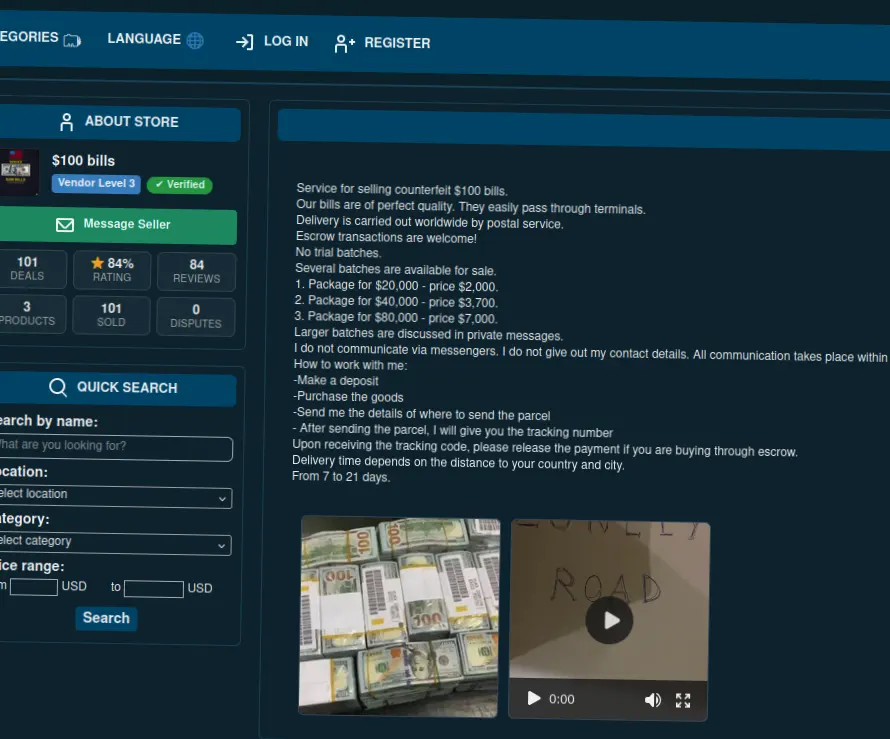
Accessing and navigating the dark web requires understanding its inherent dangers. Individuals seeking privacy or uncensored information must also recognise potential pitfalls. Even seemingly simple transactions, like purchasing counterfeit money, can have severe consequences. We will examine a specific case to illustrate these risks.
1. What did Derek H. attempt?
Derek H., who is 29 years old, lives in Denver, Colorado. In 2025, specifically in January, he acquired 40 counterfeit $100 bills from the 2009 series via a darknet platform. For this purchase, he spent $1,200 in cryptocurrency. The seller asserted that these bills were of "superdollar quality." They allegedly featured elements that resembled real currency, such as UV protection and magnetic strips. Derek's plan was to deposit these counterfeit bills into his bank account using an ATM that accepts cash. His goal was for the machine to credit the deposit to his account, after which he intended to withdraw or transfer the funds, aiming to convert the fake notes into legitimate money.
2. How did the initial deposits proceed?
Derek's scheme initially appeared successful. He used two different ATMs for his first attempts. Both machines accepted the fake 100 dollar note bills. A total of $800 was credited to his account. He then tried a third ATM. This machine returned one of the bills, indicating an error. The fourth ATM accepted the remaining fake money. However, it flagged the transaction. The status showed as "pending review." This marked a critical turning point for his operation. The website where the purchase was made did not provide any warnings about such issues.
3. What were the immediate consequences?
The day after the suspicious transaction, Derek's financial institution took steps to secure his account. This action restricted his access to his money. Three weeks later, he faced apprehension by the U.S. Secret Service. Derek's effort to obtain counterfeit $100 bills proved unsuccessful. This case highlights the severe risks linked to counterfeit currency. Even the purchase of $100 in bogus notes can lead to significant legal repercussions. It is crucial to understand that even convincingly fake money in Australia is traceable.
We recommend further reading on secure darknet practices to understand all associated risks.
4. How did the bank detect the scheme?
Banks employ sophisticated detection systems. These systems analyse ATM deposits for anomalies. They do not solely rely on physical security features. Transaction patterns are also monitored closely. A large, sudden deposit of cash can trigger a review. The same applies to multiple deposits of counterfeit $20 dollar bills or $100 notes. Even if a fake 100 dollar note passes initial machine checks, further analysis occurs. Banks compare serial numbers and transaction histories. Discrepancies lead to account freezes and investigations. This process helps uncover attempts to buy counterfeit 20 dollar bills or other denominations. The overall lesson is that the fake money site or darknet market cannot guarantee anonymity or success.
The Risks of Counterfeit Currency on the Darknet
This case highlights the substantial risks associated with acquiring fake money for sale nearby or via online platforms. The allure of a low fake dollar price for seemingly high-quality notes, such as counterfeit $100 dollar bills, is deceptive. Financial institutions have robust systems designed to identify and flag suspicious transactions, leading to severe legal consequences. Engaging in such activities, even on the darknet, rarely offers the promised anonymity or profit.
Sources
[1] Buy fake money – The surefire way to have additional financial resources
[2] high quality undetectable counterfeit money